When the canon EF-S 55-250mm f4-5.6 IS was released in 2007 and began attracting good reviews for the image quality I started to become quite interested. With IS and a close focusing distance of 1.1 metres, giving an effective magnification of 0.31 at the 250mm end of the range, it was looking like a good budget option for photographing the larger, more nervous insects such as butterflies and dragonflies. It also looked like a reasonable option for closer photography of plants at the back of borders, a necessity for situations where I couldn't get close enough in gardens other than my own. It would also be useful, I thought, for plant portrait photography in situations where I needed cleaner backgrounds than I could get with my 50mm macro. At the time I couldn't afford it's EF big brother, the 70-300mm f4-5.6 IS, let alone anything better, so I started saving my pennies and a little while later, once the price had dropped a bit, I bought one to replace an antiquated 80-200mm f4-5.6, my longest telephoto zoom.
It's tempting to say I was disappointed but that's not quite true. It's a budget lens, after all. I was comfortable with the less than stellar but still quite tough build quality - I don't abuse my lenses so I don't need tank like build. It focused accurately, the IS worked well enough to steady shots - though not to 4 stops improvement claimed, more like 2-3 stops - and the image quality is good as long as the lens is being used within its optimum parameters. Unfortunately, once outside those parameters image quality falls off a cliff. Go much over 220mm and softness creeps in. Close up quality also suffers from softness. And at close distances the IS becomes far less effective. All of these synergise to seriously degrade image quality at the extremes. Consider these shots of
Rhagium bifasciatum,
a long horned beetle who obligingly wandered across my path when I was doing the initial testing of my newly purchased lens. (Click to embiggen.)
 |
| Rhagium bifasciatum. 55-250mm at closest focus. ISO 400, 250mm, f11, 1/160, flash. Full frame shot. |
 |
| Rhagium bifasciatum. 55-250mm at closest focus. ISO 400, 250mm, f11, 1/160, flash. Centre 100% crop. |
 |
| Rhagium bifasciatum. 55-250mm at closest focus. ISO 400, 250mm, f11, 1/160, flash. Full frame shot |
 |
| Rhagium bifasciatum. 55-250mm at closest focus. ISO 400, 250mm, f11, 1/160, flash. Centre 100% crop. |
Even allowing for deficiencies in my flash technique (on hotshoe, no diffusion) and
the use of 400ISO with its greater noise the softness is obvious,
particularly when contrasted with the far greater sharpness of the same
subject taken at the same time with the EF 50mm f2.5 compact macro.
 |
| Rhagium bifasciatum. 50mm macro at closest focus. ISO 400, 50mm, f11, 1/160, flash. Full frame shot |
 |
| Rhagium bifasciatum. 50mm macro at closest focus. ISO 400, 50mm, f11, 1/160, flash. 100% crop |
The difference is fairly obvious. That doesn't mean that the lens is useless. It does mean that if you push it to the limits that performance falls off. As always, you get what you pay for. With some experimenting I did manage to generate a few reasonable results. I liked the nicely blurred backgrounds, image stabilisation and excellent working distance - but I didn't like the softness inherent in using the lens at the extremes.
 |
| Speckled Wood butterfly. 55-250mm at 250mm. Full frame. |
 |
| Comma butterfly. 55-250mm at 250mm. Full frame |
 |
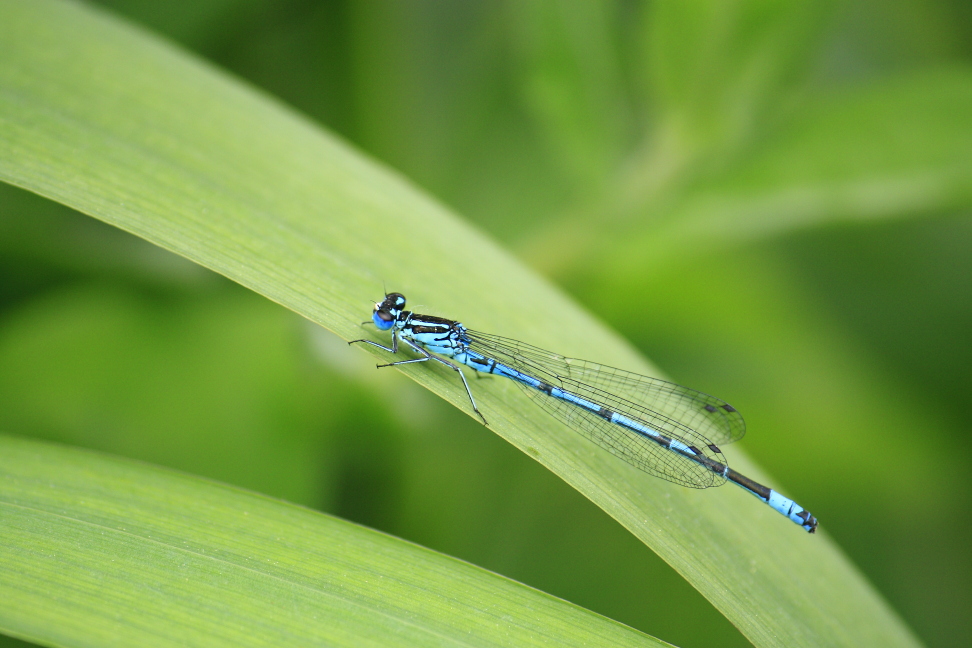
| Coenagrion puella, blue damselfly. 55-250mm at 250mm. Full frame. |
The other problem was that even with a 0.31 maximum magnification I couldn't really get close enough to fill the frame with the subject. And my EF 25mm extension tube that allowed me to go 1:1 on the 50mm compact macro didn't fit the EF-S lens. Yes, I could get EF-S fit extension tubes but only at the cost of further reducing light on what was already a slow aperture lens. Time for some lateral thinking.
Canon make a close up filter, the 500D. It's a double lensed additional optic that screws onto the lens filter threads and reduces the minimum focusing distance (measured from the lens front) to 500mm / 20in when the focal length is set to infinity. On a zoom lens like the 55-250mm it gives a range of magnifications, from about 0.1 at 55mm, infinity focus to about 0.85 at 250mm, minimum focus. In the latter case the working distance is reduced to about 12in. Restricting the lens to 200-220mm and avoiding racking out the focus to the closest limit to improve the image quality takes this down a little but still produces good magnification from 0.1 up to about 0.7x life size, well within that needed for a good range of butterfly or dragonfly shots. And all at a working distance that is far less likely to scare off flighty insects.
In June 2010 I bought one. So, how does the combination stack up?
Surprisingly well is the answer. All full frame shots.
 |
| Common blue butterfly. 55-250mm/500D combination |
 |
| Cortuledgaster boltonii. 55-250mm/500D combination |
 |
| Crane fly. 55-250mm/500D combination |
 |
| Large red damselfly. 55-250mm/500D combination |
 |
| Marsh thistle. 55-250mm/500D combination |
It's not quite as good as a dedicated macro lens. Shortly after buying the 500D close up filter I had the opportunity to pick up a Tamron 90mm macro lens at a reasonable price and the difference in the capture of small detail is noticeable. But where the combination scores is in the ability to use the best optical ranges of the telephoto and still get reasonable magnification at a good working distance. For natural light photography the IS is very useful to steady the shot. Autofocus still works though I prefer to set to manual focus, usually slightly less than infinity, and adjust magnification with the zoom ring while moving slowly closer to the subject to capture the shot as it comes into focus in the viewfinder. Because the working distance is always the same it soon becomes second nature to use the technique. Above all, the combination is light and easy to handle, whether unaided or with my flash and bracket combination. And in the field that's a valuable feature.
So, is the Canon 55-250IS the answer to a poor man's prayers for a good butterfly lens? On its own, no. Combined with the Canon 500D close up filter it comes very close by meeting the requirements for the needed combination of working distance, adequate magnification and good image quality at a reasonable price. It's certainly cheaper by far than any of the 180mm macro lenses on the market, or that other favourite of the dedicated, the Canon 300mm f4 L IS with extension tubes. Even though I've now acquired a Sigma 180mm f3.5 macro (cheaply, the pre DG model) I suspect I'll still be using this combination for field work in years to come.