Showing posts with label UK butterflies. Show all posts

Friday, April 24, 2026

 Butterfly photography again

Years back I published a post on the Canon 55-250mm EFS as a budget friendly butterfly lens on my Canon APS-C bodies.  Times have moved on, I now use Olympus/OM Systems micro 4/3 equipment, and a recent day at The Garden House when I managed to capture these male and female Orange Tip butterflies (Anthocharis cardamines) feeding on Sweet Rocket, Hesperis matronalis, reminded me of how I now use my Olympus 40-150mm f2.8 PRO and 1.4 x teleconverter as my go to combination for shooting these flying flowers.


The native lens has a minimum focusing distance of 0.7m - just over 2 ft - and a magnification at 150mm of 0.21x. By adding the 1.4x teleconverter the minimum focusing distance stays the same but the magnification increases at the now 210mm end to 0.3, allowing tighter framing.  This is the difference:

150mm on native lens

210mm on native lens + 1.4x teleconverter

Effectively I have the equivalent in full frame terms of a close focusing 100-400mm f4 zoom (actually 112-420mm if you need to quibble).  All with Olympus / OM systems PRO image quality and rugged weatherproof build.  Any compromise in image quality from adding the teleconverter is hardly noticeable.  Yes it's a little heavier than my previous Canon 80D/55-250mm combination but the results are far better.

As I've referenced in previous posts, the combination on the OM-1 it also effectively supports hand held focus stacking.  So a five image stack with a compliant subject such as this Green-veined white butterfly (Pieris napi) provides me with both greater depth of field on the subject and even better background blur and separation than the f9 aperture I was using for the previous shots.

The full image, slightly cropped

100% crop of the butterfly head

In the field this combination of relatively light weight, great stabilisation with the Olympus/OM System IBIS, close focusing to throw more pixels on the subject while keeping a good working distance, handheld stacking and excellent image quality means that I have far more flexibility when pursuing butterflies in their habitat.  As demonstrated by these few shots from previous years

Brimstone

Green veined white in flight

Meadow brown feeding on yarrow

So, a combination that's yielding excellent results in a compact and relatively lightweight package, and, just as importantly, within my budget.  Yes I might lust after the new 50-200mm f2.8 PRO but that's way beyond what I can earn from my image sales - and that sets the budget.


Wednesday, April 17, 2024

Spring garden butterflies

The local Plymouth weather has been damp and disgusting over the last few weeks but over the weekend we've had a break and the sun shone for a change.  Out at The Garden House on Friday I was down by a little, bank by the North boundary.  We encourage wildlife in the garden and this little area was filled with dandelions, ideal nectar sources for overwintering butterflies emerging from hibernation.

I captured these three within 2 minutes.

Brimstone butterfly, Gonepteryx rhamni


Comma butterfly, Polygonia c-album

Peacock butterfly, Aglais io

All were taken with the 40-150mm f2.8 Pro, at ISO 800 and f4.  I've used Lightroom denoise on the Peacock and Brimstone, though, at ISO 800 on the EM1 Mkii, they produced acceptable noise results without but gave a slightly smoother background and a little detail enhancement on the subjects. With the bright but hazy light on the day I was working between 1/2500 and 1/5000 of a second, more than fast enough to freeze any movement in the slight breeze.  As I've found in the previous couple of years this combination of close focusing Olympus Pro zoom and EM1 Mkii are ideal for handheld photography of larger butterflies.  Add in Denoise and I'm feeling confident that I can go up to 3200 ISO and still get good, publishable results.  

Looking forward to the summer!

Thursday, January 18, 2024


I have a little list....redux

Back in 2013 I added a post about missed butterfly opportunities.  Time moves on and the last couple of years have actually been very productive in terms of filling a few gaps.

Lets start with holly blues, Celastrina argiolus.  Double brooded, with spring and summer variants, they were prolific during summer in the Plymouth area last year, and, for the first time, I actually managed to get some good shots.  They tend to be a little skittish and my lens combination of choice with the EM1 Mkii was the 40-150mm f2.8 and 1.4x teleconverter to give me both excellent working distance; fast, accurate autofocus; and sharpness wide open.


One was even good enough to land to feed on the potato flowers in my back garden.  60mm macro for this shot.


With the number flitting around I'm hoping the spring brood will be equally prolific in 2024 and I can get shots of the darker spring form - and maybe a few shots with wings open.

I'd already found a couple of locations for small coppers, Lycaena phlaeas, in the Plymouth area and had a few shots post 2013 but I was delighted to find that they'd also moved into the no mow area 100m from my house and that yielded a number of good shots.


Attractive little things, they share a habit with their distant cousins the common blue, Polyommatus icarus.

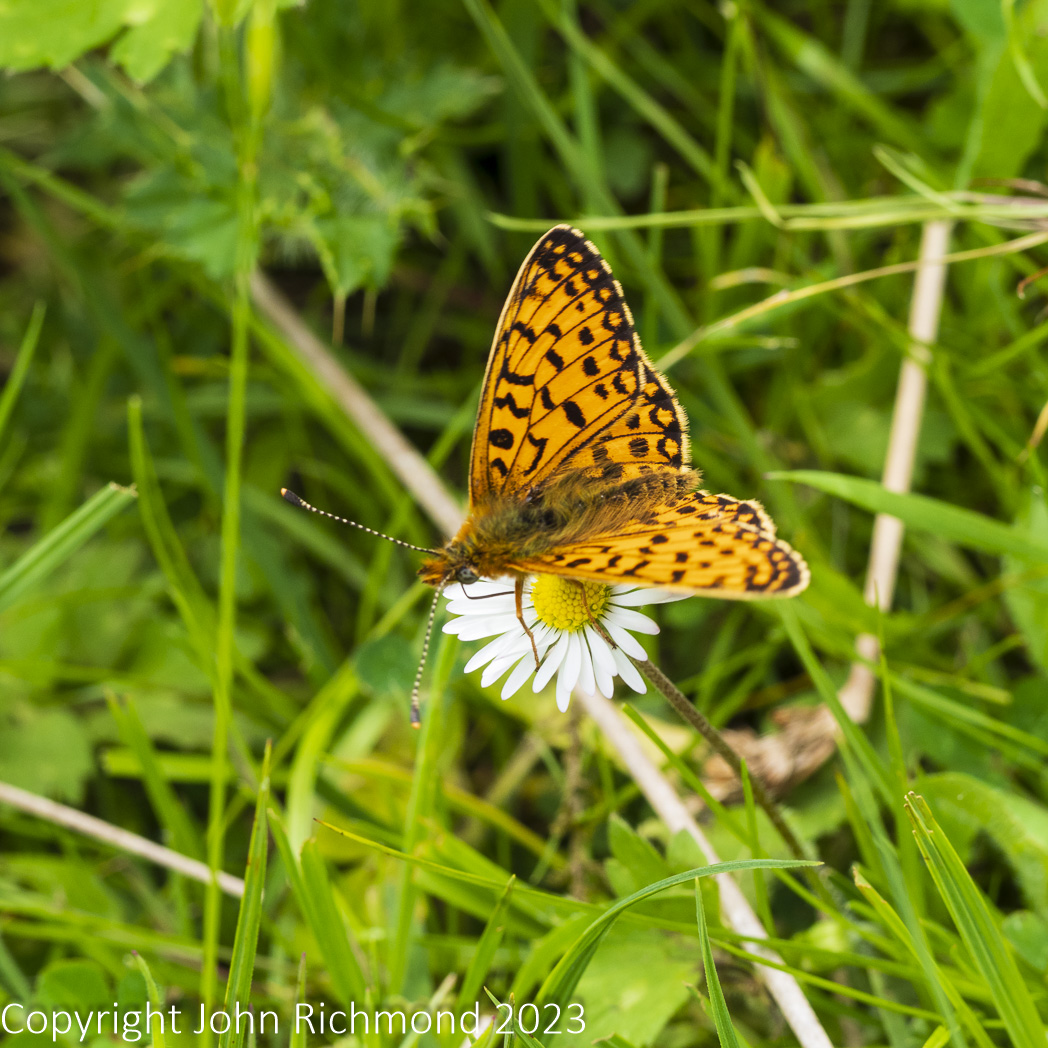
There is a walk up to the moors at Shipley Bridge, near Buckfastleigh in Devon.  Paved, it's an ideal day out for Maria on her mobility scooter.  Once out of the wooded area and on open moorland I had my first sighting of the lovely small pearl bordered fritillary, Boloria selene.

Here's the male:


And the female:


I'm still looking for green hairstreaks and walled brown butterflies - but that's all part of the fun.  2024 maybe?