Showing posts with label no mow. Show all posts

Saturday, December 16, 2023

No mow and other insects

As mentioned in the previous post the experiment by Plymouth City Council to create meadow areas from previously mown grass areas has certainly attracted a number of meadow butterflies.  Needless to say it's also attracted a fair few other insects that require the same type of habitat.  I've illustrated a few of the more colourful or interesting that I photographed this summer.  I've no doubt I missed many more - but there is always next year!

Potato capsid bug, Closterotomus norwegicus

Male tawny mining bee, Andrena fulva

Male hoverfly, Sphaerophoria scripta


Tachinid parasite fly, Ectophasia crassipennis.  This has only recently been added to the UK tachinid list but seems to be spreading quite rapidly along the South coast.


Parasitic wasp, Ichneumon suspiciosus


Largest of the UK hoverflies, the hornet mimic Volucella zonaria


Rhopalid bug, Corizus hyoscyami

The smaller size of these specimens required the use of the Olympus EM1 MkII, 60mm macro and STF-8 twin flash combination.  They work well together, providing a compact, lightweight system that can generate excellen quality.  I usually work between f8 and f10, 1/250 sec, ISO 200 and use the Manual setting on the selector dial to let the flash do the work, setting any flash exposure compensation as required.

As with the butterflies, it was fun capturing these shots.  The primeval thrill of the hunt underlies most wildlife photography and even macro work with free ranging insects is no exception.  Even if my now ancient knees do tend to object!


Wednesday, December 13, 2023

No mow and butterflies

During the Covid lockdown times Plymouth City Council decided to designate certain areas of previously regularly mown grass as no mow meadowland.  One such area starts less than 50 yards from my house in the Whitleigh area of Plymouth.  The cynic might say that this was just a cost cutting exercise - but the ecologist and photographer in me was delighted to see what would turn up now the grass wasn't being razed on a regular basis.

I had time on my hands this summer.  Unable to get further afield as often as before, a regular couple of hours among the new meadow area seemed like an ideal photo opportunity.  And so it proved.

The gear of choice was my Olympus EM1 MkII, 60mm macro with STF-8 twin flash, and 40-150mm f2.8 and 1.4x teleconverter.  I took a monopod to support the gear. Even with the effective IBIS and light weight of the camera and lenses it helps to have a little extra stabilisation.

The results delighted me:

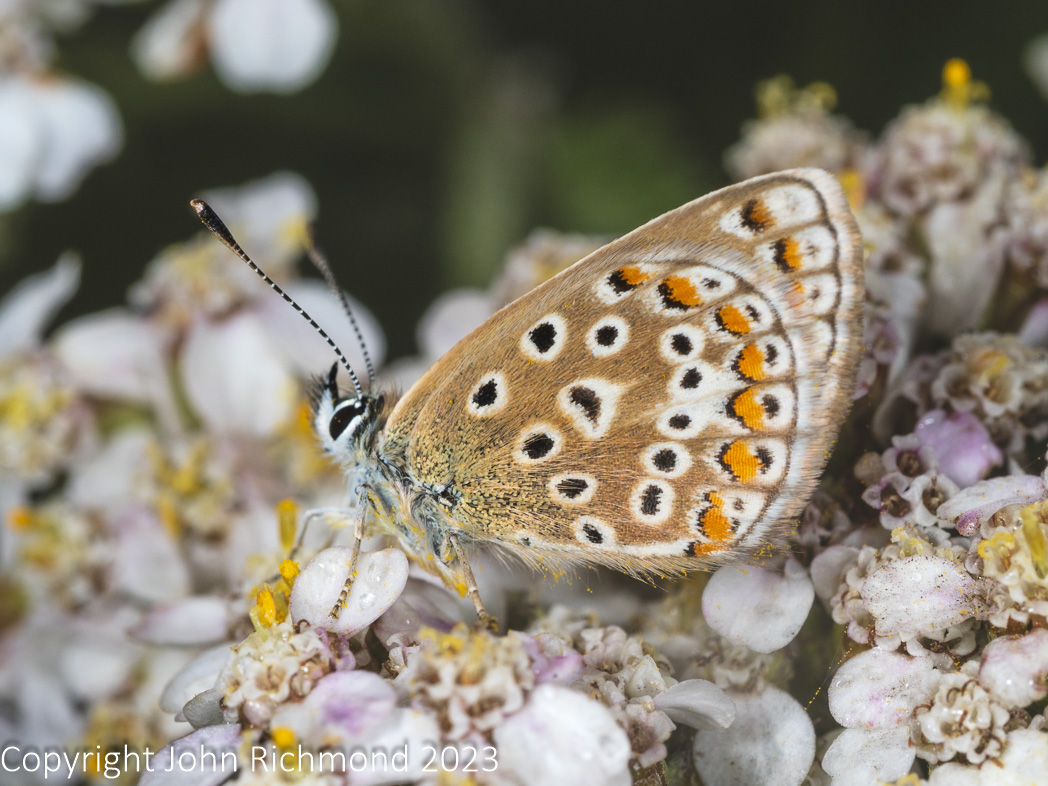
Common blue, Polyommatus icarus


Gatekeeper butterfly, Pyronia tithonus


Large skipper butterfly, Ochlodes sylvanus


Marbled white butterfly, Melanargia galathea


Meadow brown butterfly, Maniola jurtina


Small copper butterfly, Lycaena phlaeas


Because the grass had been previously mown on a regular schedule only the hardiest nectar plants had survived. Principally Achillea millefolium, yarrow and Centaurea nigra, knapweed, they have provided a nectar source for these meadow butterflies, allowing them to colonise and flourish in what was previously rather sterile ground.  There are many who would consider the no mow results as being rather untidy - but for the colonising butterflies it's a new and previously unavailable space.

Of course it wasn't just butterflies that came in.  Many other insects alos arrived. But that's a story for another post.