Showing posts with label insect photography. Show all posts

Sunday, June 21, 2026

An encounter with Hummingbird hawk-moths

Years ago - September 2013 to be precise - I took one, very lucky, shot of a Hummingbird hawk-moth, Macroglossum stellatarum,  Here's the shot:


Lucky in the sense that I was photographing this Ceratostigma willmottianum in my garden and the moth appeared, paused briefly to drink nectar, and then flew off, giving me time for only the one shot.  Lucky in that I had the Sigma 105mm macro on my, at the time, Canon 60D.  Lucky in that I was working at ISO 400, f6.3, and 1/200 sec and I somehow managed to get the eye, flower and proboscis reasonably sharp.  

Unfortunately everything else was blurred.  No wonder it's never sold.

I've seen these occasional UK summer migrant moths a few times since but never again managed to successfully photograph them.  Until last Monday.

I was working at The Garden House, collecting my usual social media shots.  I'd temporarily fitted the 100-400mm to the OM-1 to capture some nesting Jackdaws in the roof space of the old bothy behind the Walled Garden. I had bird detect on, continuous autofocus and sequential shooting set, ISO 1600 selected and the lens wide open at f6.3, giving a shutter speed between 1/000 and 2/1000 sec.  I happened to be near a patch of Nepeta (catmint) when a Hummingbird hawk-moth came to feed.

And then the fun began.  

Like hummingbirds these little moths flit about in unpredictable direction, wings blurred with the speed of their motion, briefly hovering in front of a flower to insert their long proboscis and drink the nectar.  Above all, they never settle while feeding.  Blink and they're gone.  Surely the harshest test of an autofocus system possible.  I had a lot of failures.  As evidenced by these three shots:


At first sight they look quite reasonable (I've cropped the images to square format only to cut out some extraneous content at the sides)  Now look at a 100% crop of the last image.


Not quite the success it appeared to be on first examination.  The swift, unpredictable, darting flight was producing real problems in attaining and keeping focus on the moth.  The others are slightly better but they've still missed focus.

But gradually, and aided by the arrival of a second moth*, I started getting a few better shots.


Sharper, more detailed and, most importantly, with better focus accuracy.  There's still the problem of wing blur but I didn't have enough light to raise the shutter speed to further freeze motion.  

In the end I finished with 3 shots I was reasonably happy with, and another shot (#1 in the final sequence) that was passable out of 46 in total.  The 100-400mm autofocus is just fast enough for the job though I suspect the PRO series lenses such as my 40-150mm might have been a bit faster and more capable of holding focus.  But you work with what you've got and an unpredictable small insect in flight would test any camera and lens combination.

An enjoyable experience.  I'd have continued but the moths took off for pastures anew and I didn't see them again.

* How do I know there were two moths?  Look at the backs.  One is fully covered, one distinctly worn where the scales have been rubbed away.


Sunday, July 13, 2014

1.4 + 25 + 180 + 430 = long distance macro

It's not maths.  Or, even worse, algebra.

The 1.4 is the Sigma 1.4x teleconverter that I bought last October (used from MPB Photographic.  I've had a couple of items from them and their service has been excellent.  Highly recommended if you're in the UK.).

The 25 is my Canon 25mm extension tube.

The 180 is my Sigma 180mm f3.5 IF HSM macro lens, the older, non DG model.

The 430 is my Canon 430EX flash.

Add in a Kirk macro flash bracket, off camera cord*, softbox diffuser and, of course, a camera and they make up my tripod mounted macro flash kit.  It's big, it's fairly heavy, it's unwieldy - but the results are great.


A lot of my macro flash work so far has been carried out with the kit I've illustrated previously.

Freehand macro flash kit - Tamron 90mm macro, 25mm extension tube, 430EX on bracket
I still use it but it's got two problems.  Firstly, I'm getting on a bit and there are days when I can't hold the combination freehand and reliably nail focus with any degree of accuracy.  To be blunt, I shake a little and, unless I can contrive some support - sitting on a camp chair with elbows on knees works well - even flash images can blur and miss focus.  Secondly, working distance is low and I often need a bit more separation between myself and the subject.

So this is the solution:


Tripod mounted macro flash setup

It gives me a working distance of  about 12-18in / 30-45cm for macro ratios from 1:1 up to about 1.6:1.  The extra working distance allows the tripod and gear to be manoeuvred into position without upsetting nervous subjects.  When working completely with flash the lighting is close enough to the subject to freeze motion now I don't have to worry about camera shake - and far enough away to give a more natural appearance to the background as the flash intensity doesn't drop off as rapidly as it would with closer work.  And these are the type of results that ensue.  All shots are full frame.

Female long legged fly, Dolichopus ungulatus

Calliphora vicina, a male bluebottle blowfly
The combination also works well with natural light / fill light for slightly larger subjects taken at a greater working distance:

Immature female violacea form of the blue tailed damselfly, Ischnura elegan


As can be seen from the watermarking on the three images, the quality at 100% passes the QC hurdles for acceptance by Alamy.  Yes it's unwieldy.  I can manage the weight easily enough although manoeuvrability is a little lacking.  It's not as flexible as my hand held combination - but the ability to accurately set focus more than outweighs any loss in flexibility.  In short, it works for me, and I'll be using it for many more shots to come.

*To answer the obvious question of why I don't use the wireless flash facility of the Canon 600D with my 430EX it's a matter of convenience.  I don't have a separate cold shoe to mount the flash on the bracket so I use the off camera cord. 

Monday, June 10, 2013

Dallying with the damsels

Damselflies that is, smaller and more delicately built than their larger dragonfly cousins, but equally photogenic.  Over the last couple of weeks I've been able to capture a few nice shots of three of the commoner local species, a promising start to the summer.

It started with a female Large Red damselfly, Pyrrhosoma nymphula, in the typica colour form, that wandered into the front garden at the end of May, giving me a chance for a few shots - including a close up.


Pyrrhosoma nymphula forma typica -  female large red damselfly
A few days later a male showed up round the little pond in the rear garden and posed for long enough to allow me to get the 180mm macro lens onto a tripod to do some natural light / fill flash photography.

Pyrrhosoma nymphula  -  male large red damselfly
The hard part, as always with side views of insects, is getting the whole damselfly parallel with the sensor plane so that both the head and tip of the tail are in sharp focus.  Practice helps - but blind luck and a good few tries seem to be as important.  The extra working distance of the 180mm macro lens really helps.
Pyrrhosoma nymphula  -  male large red damselfly
A little further afield - well, close to the woods where I walk the dogs - I came across both male and female common blue damselflies, Enallagama cyathigerum.  Well away from the still water they prefer, they were both a bit skittish but, eventually, I managed to get some reasonable shots.
 
Enallagama cyathigerum - common blue damselfly male

Enallagama cyathigerum - common blue damselfly female
Meanwhile, on the streams that flow down from Dartmoor, Beautiful Demoiselle damselflies are emerging.  Calopteryx virgo is one of two UK species with pigmented wings, brown in the case of females and immature males, iridescent blue in mature males.

Calopteryx virgo - immature male

Calopteryx virgo - immature male beginning to develop the blue wings of maturity
At the location I took the two shots above I didn't manage to capture an adult male - so here's one I photographed a couple of years ago.  They'll be more common in a few days, ready for my next trip out.
Calopteryx virgo - mature male
Of course, typically for immature males of any species, some can be very vain.  This one was quite happy to allow me to set up the 180mm macro and tripod at 1:1 working distance (about 18cm), maneuver around, and fire off multiple shots at close range to get some different views than the conventional side on or top down shot.  It even obligingly switched backgrounds while staying close to me.  In the second of the shots it's eating its lunch, a small midge.

Calopteryx virgo - frontal view of immature male

Calopteryx virgo - frontal view of immature male
An enjoyable start to what I hope will be a productive summer.

As always, click the pictures to access the larger versions.

Tuesday, October 16, 2012

The hoverflies of summer

The marmalade hoverfly, Episyrphus balteatus, on Meconopsis cambrica in the garden

I freely admit that I'm no insect expert but my training as a zoologist / ecologist does allow me to use taxonomic keys to roughly identify most of the larger insects down to family or even genus level.  After that I'm reliant on the quality of my photographs to pick out identifying features which can help in the trawl through Google images and other resources to identify particular species.  So it is with hoverflies.

Beyond a vague knowledge that there are quite a few different species in the UK (about 250), that many mimic wasps and bees in their protective coloration, and they act as efficient - if indiscriminate - pollinators I'd never really looked at them in any detail.  By 2010, however, I'd put together the macro flash rig I illustrated in the previous post and was looking for subjects.  And hoverflies suddenly swam into focus.

I don't specifically garden for pollen feeding insects but I do grow a lot of plants that provide abundant sources throughout the warmer months.  Which means the garden is a good source of subjects.  I also live close to one of Plymouth's suburban nature reserves and walks through there are usually productive.  So it was that I started to put together quite a few photos.  And then the ID problems started.

Some were easy.  Episyrphus balteatus, the marmalade hoverfly, is pretty distinctive in its orange and black markings.  Equally easy to ID was the long snouted Rhingia campestris.  You can't really mistake it for anything else -  even though I only saw it once and only managed a single shot earlier this year and I often need a few for ID purposes.

Episyrphus balteatus

Rhingia campestris in the local nature reserve
Also distinctive is the yellow and black vertical banding on the thorax of Helophilus pendulus.  I should probably be worried about finding this in the garden.  The larvae live in muddy ponds and ditches - which suggests its time to finally do some cleaning in my little garden pond.  A messy job that I've been putting off.

Helophilus pendulus in the garden
Some of the other wasp mimic hoverflies are harder to tell apart for the amateur insect photographer.  Take the following two:

Meliscaeva cinctella

Syrphus ribesii
Taken moments apart on the same flower head, it was only when I got the shots uploaded after I returned home that I realised I'd captured two entirely different species.  I simply didn't (still don't) know hoverflies well enough to have an instinctive knowledge of them.  An important lesson comes out of that.  With unfamiliar wildlife and the marginal cost per shot of digital it makes sense to keep shooting even if you think you've already captured a good shot of your subject.  You may be capturing something completely different without realising it.

I'd like to think I was working to that philosophy when I took this capture of Myathropa florea feeding on my Sedum spectabile earlier this year.  It's not one of my better shots - but I could easily have ignored the hoverfly thinking it was one I'd already photographed.
Myathropa florea


Then there are the hoverflies that are relatively easy to identify to the genus level but after that it's a nightmare.  Sphaerophoria is a case in point.  Fifteen British species and the only one that can be identified with certainty from photographs is the long bodied male Sphaerophoria scripta.  The one below is female - you can tell from the wide separation of the compound eyes, males are narrowly separated - but apparently they can only be correctly identified from microscopic differences in the genitalia.  So, much as I would like to identify this one as Sphaerophoria fatarum - the markings match - I can't.

Sphaerophoria sp.  Possibly S.fatarum
At least these two Eristalis honey bee mimics are easier to identify.  At a distance the mimicry is effective - but close up it falls apart a little.

Eristalis pertinax
Eristalis tenax
 Apis mellifera, the honey bee the two Eristalis are mimicing
So far, I've only just lightly scratched the surface of hoverfly photography.  The challenges for next year will be to shoot (and hopefully identify!) more species and to start shooting more natural light shots with my newly acquired Sigma 180mm EX HSM f3.5 macro.  But at least I can now identify two of the three hoverflies I shot in early September this year, companionably feeding on the abundant pollen of Meconopsis cambrica.

Syrphus ribesii (t), Eristalis pertinax (r) and an unknown small species on Meconopsis cambrica


Tuesday, October 9, 2012

The slow evolution of a macro nature photographer


It's hard to say when I got into close up and macro nature photography.  My first 'real' camera was an Olympus OM10 (with manual adaptor!) and it didn't take me long to get a set of extension tubes to add to the 50mm and 135mm lenses I'd bought with the camera in the mid 80's.  But I was always limited by the cost of film and could only afford to use the occasional roll to go closer than I normally did for my main plant and garden subjects.

Olympus OM10, T20 flash, extension tubes on 50mm lens.  I keep it for sentimental reasons.  No reasonable offer refused.
68mm of extension on a standard Zuiko 50mm lens gives about 1.3:1 of magnification.  An insect or flower 25mm broad would occupy the full width of a 35mm frame.  True macro territory.  But limited by a very short working distance from the front of the lens to the subject and no bracket / off camera cord to bring the flash close to the front of the lens to provide enough light to freeze motion for more mobile subjects.

I'd shoot the occasional butterfly, dragonfly, or larger insect hand held, using the 20 or 36mm tube in the set and exploiting the extra working distance of a 135mm 'close focus' (3ft/0.93m!) lens.  The results weren't fantastic though just about good enough to use to illustrate the odd on line article when scanned on my old Olympus scanner.  Typically, I've only kept some low res images - but I still have the original slides and could re-scan if needed.

Our thanks to John Richmond for this image
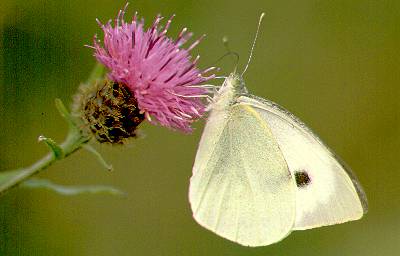
Large white, Pieris rapae, taken in the 1990s
Then came digital.  After a brief dalliance with a Minolta digicam I raided the piggy bank in December 2004 to buy a Canon 300D, the first affordable (sub £1000) DSLR.  It was about a year after it came out and prices had almost halved.  Once purchased, the incidental cost of shooting is virtually zero so I could finally experiment.

Rather than extension tubes I went for my first macro lens, the Canon 50mm f2.5.  It only goes to 0.5:1 (half life size) unaided but can manage 1:1 (life size) with a 25mm extension tube.  On the smaller sensor 300D I could shoot at about the same equivalent magnification as with the Olympus gear.  Bought used, I had a basic macro set up for less than £200.  Results were better than I hoped.  The long years of practice handholding and supported with a tripod had obviously had some effect and I was producing shots that I was pleased with.

Shots like these from 2005:

Phygelius 'Salmon Leap'.  1/100sec, f3.5

Libellula depressa.  1/250sec, f13
Tricyrtis hirta, single flower detail.  1/60sec, f9

I was happy for a couple of years.  I could capture lots of detail and, more importantly, could keep shooting until I was satisfied that I'd got the shot, something I could never afford to do with film.  But it still wasn't quite enough.  I needed more working distance for the more active insects and to use longer focal lengths to narrow the field of view and produce smoother backgrounds.  I needed off camera flash for smaller insects. 

In 2008 I bought a used 400D and 430EX flash.  Adding the 25mm extension tube to my previously acquired Canon 28-135mm f3.5-5.6 IS and 80-200mm f4-5.6 II (an underrated lens for a rock bottom cheapo) gave me extra working distance and softer backgrounds but the image quality wasn't up to 50mm macro standards.  For all that I got a few decent shots, either tripod mounted or using the flash with a diffuser on the hot shoe.

Early purple orchid, Orchis mascula.  Canon 28-135mm IS, natural light

Brimstone butterfly, Gonepteryx rhamni 80--200mm, flash
Time moved on and by 2010 I'd invested in a Tamron 90mm f2.8 macro lens together with a Kirk macro flash bracket and off camera cord for the 430EX flash.  It all looks a bit ungainly - but the results I'm starting to get after three summer's use are becoming increasingly satisfying.  And tripod mounted, the Tamron is great for natural light plant photography.

400D, Tamron 90mm, Kirk bracket and 430EX - my relatively low budget macro flash kit
Empis livida - a robber fly, taken in 2010 with this kit
Lasioglossum calceatum.  2012.  I added a 25mm extension tube for this one.
An unidentified (as yet) small hoverfly.  2012
Of course, I still like natural light - maybe with a bit of fill flash - but that brings its own problems.  One budget solution I've tried is the cheap (ish), close focusing 55-250mm f4-5.6 lens combined with a Canon 500D close up filter.  By focusing with the zoom ring it runs from about 0.2:1 to 0.8:1, all with a 20in / 50cm working distance.  When it works well its surprisingly good - as I'll look at in another post and as illustrated by the shot below.

Utetheisa pulchella, the Crimson Speckled Flunkey, a day flying moth I photographed in Cyprus with the 55-250 / 500D close up filter combination.
That has all the requirements of soft light and the clean background that comes from the narrow angle of view inherent in a longer telephoto lens.  What it doesn't have is the absolute clarity of a good macro lens / higher resolution sensor combination. Which is why, thanks to a small legacy, I've just upgraded my camera to a Canon 600D and added a used Sigma 180mm f3.5 macro (pre DG) to my lens kit.  Another learning curve to be tackled!